
GitKraken
Product Manager (Accounts, Billing & Growth) · 2022–26
At GitKraken I owned accounts, subscriptions, and billing across a suite of developer tools serving 100K subscriptions, and worked on growth and AI with other PMs. With engineering and design, we redesigned checkout, made billing reliable, and grew seat expansion. I also started the company's first AI evals.
Team. Grady was the product manager; results were achieved with engineering, design, marketing, and data teams, and credit is shared.
+60%
organic seat expansion
Team result; credit is shared with the GitKraken team.
55→75%
AI commit-message upvotes
User thumbs-up rate on generated commit messages. Shipped with engineering teams.
−80%
billing support tickets
Shared improvements with engineering; the exact period is not pinned down.
100K
subscriptions
100K is the number of subscriptions the systems served, not a result.
Checkout redesign and a year of tests
A researched checkout redesign, then A/B tests, raised checkout conversion about 15%.
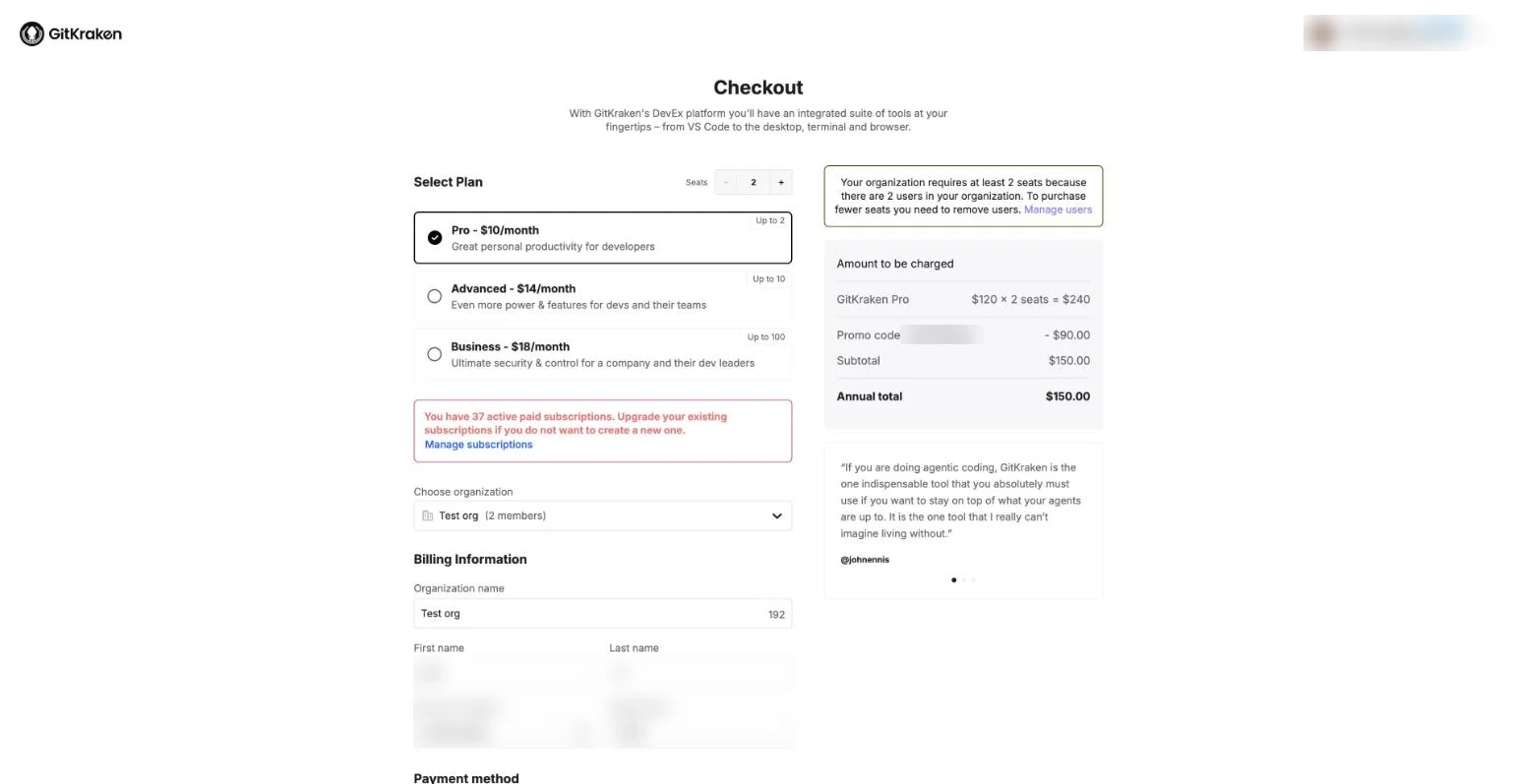
Checkout confused people, created support tickets, and didn't inspire confidence at the moment of purchase. I collected checkout screens from popular products with similar business models and laid them out on one page to find the patterns.
I partnered with design on a new checkout. We built it, A/B tested it, saw a substantial lift, and rolled it out. Smaller tests across checkout, login, and onboarding followed for about a year.
Together they raised checkout conversion about 15%. That number covers the redesign and the year of tests, not the redesign alone.
I also moved GitKraken Desktop off an embedded checkout onto the central purchase flow. It keeps the right account and organization, matches the message to what prompted the purchase, and sends people back where they started.
+15%
checkout conversion
Cumulative across the redesign and a year of tests, not the redesign alone. Team result.
Purchase before sign-in, in under two weeks
A browser-based v0 covered about 90% of the flow for a fraction of the build.
Leadership wanted people to buy before creating an account. Adjacent tests and market research suggested a full build would be expensive for little likely impact.
With engineering and product, I shipped a browser-based v0 in under two weeks that covered about 90% of the intended flow. That made the idea cheap to test before committing to the full build.
The 90% is flow coverage, not a conversion result.
~90%
of the purchase-before-sign-in flow, in under two weeks
"About 90%" is how much of the flow it covered, not a conversion result. Shared with engineering.
Making billing reliable
A support-to-engineering loop and targeted fixes cut billing tickets about 80%.
The billing system held about ten years of work by many people, and nobody understood all of it. I learned its behavior and limits with engineers until changes that had seemed impractical became possible.
I set up a direct line from support to engineering so issues stopped getting lost, tracked trends, and pushed the right bugs and architectural fixes up the list. Billing-related tickets fell about 80%, a result shared with engineering.
One fix: a scheduled downgrade blocked customers from any further plan or seat changes without support. Engineering had blocked edits on purpose, because tracking several pending changes risked calculation errors. I proposed recalculating the scheduled change whenever the customer edits their plan. The team adopted it.
I also worked on in-product warnings before access is lost: failed payments, expiring cards, and upcoming cancellations, shown to admins and to the developers affected.
−80%
billing support tickets
Shared improvements with engineering; the exact period is not pinned down.
Accounts, organizations, and SSO
Simplified account management for the majority and led SSO.
The old account site was built for resellers managing many organizations, a minority of users. Most people had one organization and still had to dig into it to manage their subscription.
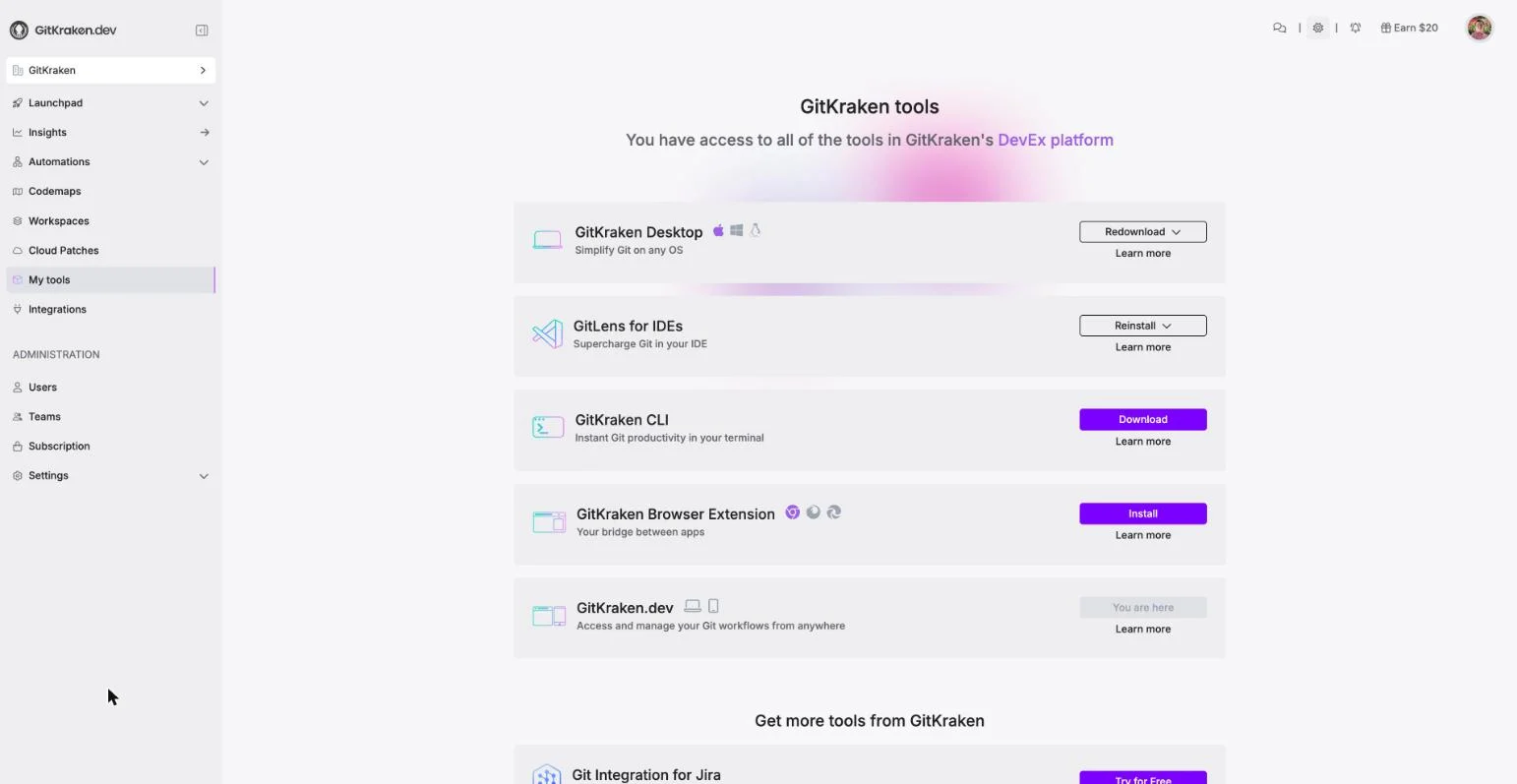
I redesigned billing, subscription, and account management from the ground up and moved it to gitkraken.dev to simplify the common path.
I led product design and implementation of single sign-on (SSO).
International tax
Extended tax support beyond the US to the EU, UK, Australia, and Canada.
As sales grew abroad, I worked with finance, legal counsel, engineering, and our tax and billing vendors to support tax in the EU, the UK, Australia, and Canada.
I learned the requirements, coordinated the billing UX for each region, and reached out to customers for the tax details they needed to provide.
Internal admin platform
Rebuilt the admin site so support and customer success could help customers without engineering.
I owned the internal admin site and rebuilt it with engineering on a new stack. It gained many capabilities and became easier to extend.
Support and customer success could manage trials and product access themselves instead of waiting on engineering.
I also defined self-service workflows for reseller quotes and purchase-order purchasing, which had taken much of customer success's time.
Growth: plans, expansion, retention, referrals
A student plan, domain matching, a cancellation flow, and a referral system.
Student plan: a new plan and packaging experience raised new-subscription conversions 15%.
Domain matching: matching people to their company's organization grew the organic seat-expansion rate 60% in one year.
Cancellation flow: a new flow, iterated on with performance data, lowered churn 10%.
Referrals: I led research, design, and implementation of a referral and affiliate system that brought a steady stream of new users.
These were team results with engineering, design, marketing, and data.
+60%
organic seat expansion
Team result; credit is shared with the GitKraken team.
+15%
new-subscription conversions
Team result; credit is shared with the GitKraken team.
−10%
churn
Team result; credit is shared with the GitKraken team.
Pricing and plan changes at scale
Pricing and plan changes across systems serving 100K subscriptions.
I owned pricing and plan changes across account and subscription systems serving 100K customer subscriptions.
I worked closely with the CEO, CFO, CMO, CPO, and teams across the company. A mistake here means wrong charges or lost access, so each change was executed with the rigor needed to avoid both.
100K
subscriptions
100K is the number of subscriptions the systems served, not a result.
GitKraken's first AI evals
Human benchmarks and tuned LLM judges took commit-message upvotes from 55% to 75%.
Commit-message generation was our most popular AI feature, and its ratings were poor. Waiting on user feedback was too slow, and every future AI feature would need a way to measure quality. So I started GitKraken's first eval framework.
I gathered hundreds of real commits with full context, defined four scores with developers, and had four developers hand-score 100 examples as the benchmark. I built one LLM judge per score and tuned each until all four were within 1–5% of the human ratings.
Calibration surfaced what the judges missed: they checked technical correctness, while developers penalized speculative claims the diff didn't support.
I iterated on the prompt with prior commit messages as context until every score rose, then chose a model on score, cost, and speed. After the change shipped with engineering, upvotes rose from 55% to 75%.
55→75%
AI commit-message upvotes
User thumbs-up rate on generated commit messages. Shipped with engineering teams.
Simplifying AI credits
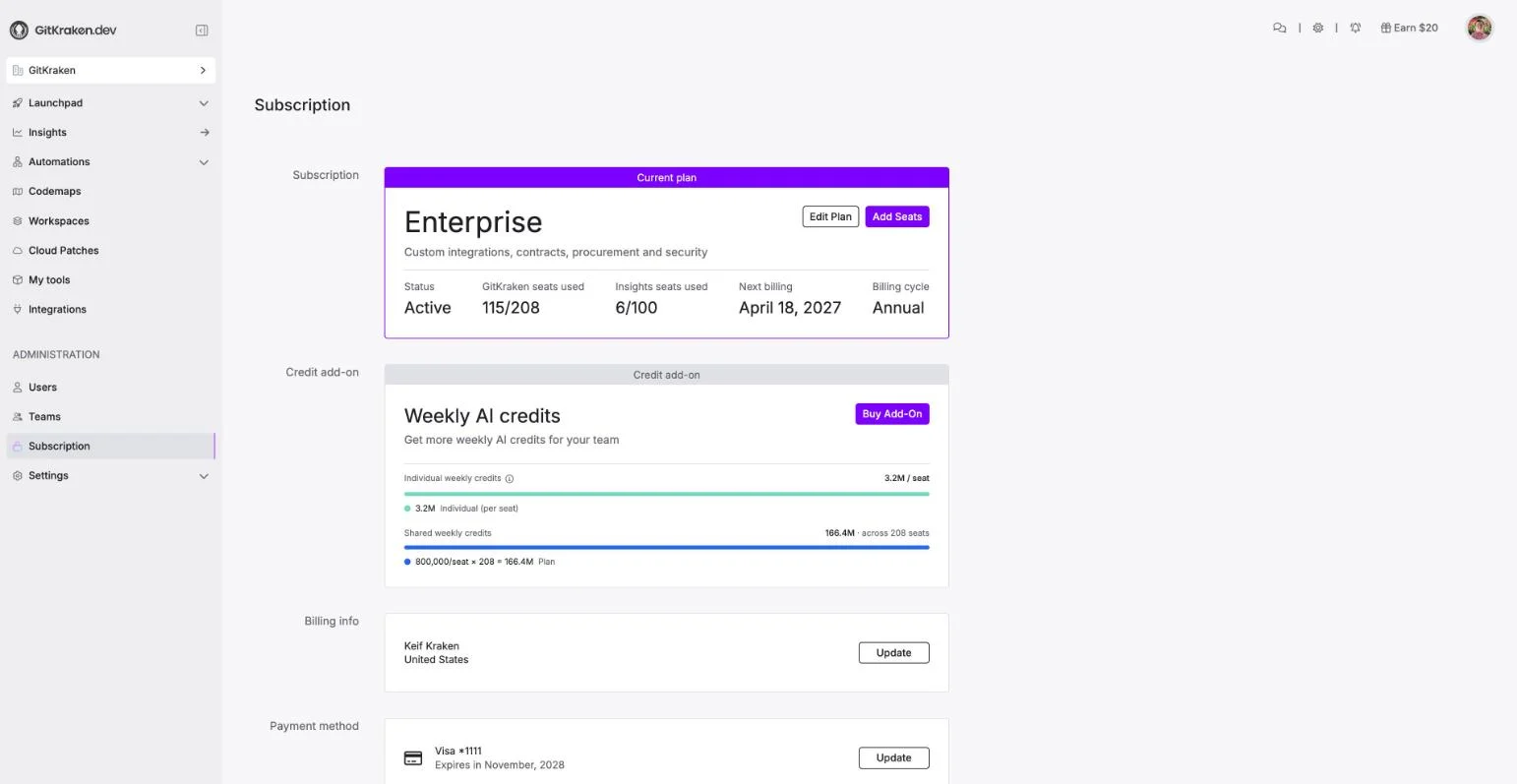
Turned a three-part credit proposal into one organization-level pool.
GitKraken needed AI credits that turned model usage into dollar value. The first proposal combined individual increases, organization increases, and individual sharing.
I researched comparable systems and cut the requirements to two principles: support individual and organization features, and stay simple for users. I proposed one organization-level pool, citing Figma as a comparable approach.
I checked feasibility with engineers, wrote the proposal and PRD, and recorded a walkthrough of the options and my recommendation. Stakeholders agreed to the simpler design.
AI-native product work
Agentic planning, working prototypes, and analysis that sped up the whole team.
Planning: agentic workflows across research, PRDs, and issues, with rich context and reusable templates, cut draft-to-ready time about 4×.
Prototypes: working prototypes built with AI coding tools cut design back-and-forth about 4×. Draft implementations before handoff sped up development by up to 2×.
Analytics: an agentic workflow with direct access to our analytics platform turned hours of digging for causes and trends into minutes.
~4×
faster draft-to-ready planning
Approximate.
~4×
less design back-and-forth
Approximate.
Up to 2×
faster development
Approximate.
Hours → minutes
to find causes and trends in analytics